more from Artist Proof Art Symposium Ein-Hod, Israel
Orna Ben-Shitrit Photos (via AP2007 )
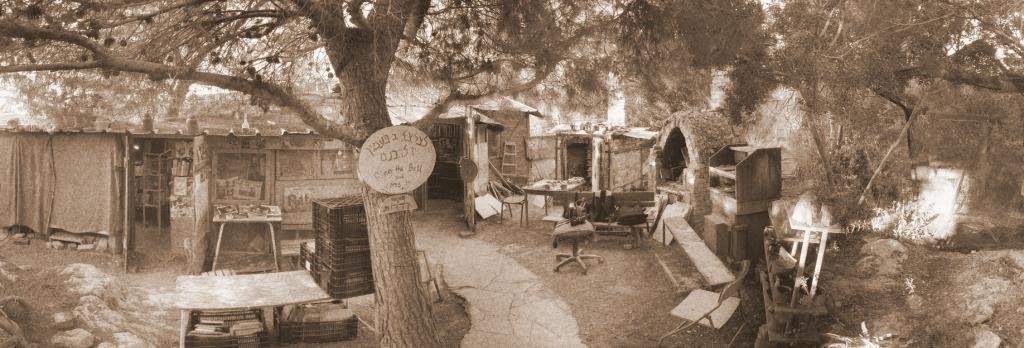
Press meeting in Yanko Dada Museum, Ein Hod.
look for an old post on AP 2007 ein hod
(more on the site)
During July 1-10 an international gathering of artists will take place in Ein Hod , Israel . The participating countries : England , Poland , Spain , El Salvador , Italy , Rumania , Kosovo , USA , Israel .
During the symposium the artists will visit significant historical sites and will be exposed to local art and meet with local artists.This will create opportunities for future collaboration and exchange of ideas between local and international artists.
The sites to visit are : Carmel coast: Ceasaria, Zichron Yaacov, Daliat El Carmel, Haifa city and Akko .
The symposium will end with an exhibition titled "Meeting Point" in "Castra " center for business and the arts , Saturday 07/07/2007 at 19.00 hour.
The event will be covered by local media and art critics in the various fields. It is the organizers' intentions to make this event a continuous project for the coming years.

In the early 1970s, novelist Bellow discovered anthroposophy, the "spiritual science" developed by Austrian thinker Rudolf Steiner (1861-1925). According to Bellow biographer James Atlas, the wiseguy Chicago writer regularly attended Windy City sessions of the Anthroposophical Society, kept a photo of Steiner on his desk, practiced Steiner's meditation exercises, bought his books by the bagful, and pursued the Steiner scholar Owen Barfield for further illumination. Charlie Citrine, the Bellowish protagonist of the future Nobel laureate's next novel, Humboldt's Gift, could be found intently studying Steiner's Knowledge of the Higher Worlds and Its Attainment in a Madrid hotel room.
Steiner believed modern materialism blinds us to a spiritual world we can reach through our senses and inner consciousness, yet he also declared a variety of more controversial and bizarre beliefs over his decades of frenetic lecturing and writing. Steiner warned against a devilish spirit named Ahriman, who threatened the world; discussed the activities of the Buddha on Mars; advocated reading to the dead; accepted reincarnation and karma (the idea that actions in past lives affect present ones); and proclaimed acquaintance with the Akashic records of everything that has happened in the universe.
Bellow wrote a foreword to The Boundaries of Natural Science, a book of Steiner's lectures, and often spoke warmly of anthroposophy, remarking: "It puts back into life a kind of magic we've been persuaded to drop. ... When Steiner tells me I have a soul and a spirit, I say, yes, I always knew that."
Atlas argues that the novelist never became a full-fledged "mystic." Ruth Miller, another Bellow biographer, recalls Bellow confiding that he didn't believe in clairvoyance, the Ouija board, or spirits, but did accept the spirit and soul and an afterlife, just like Whitman and Tolstoy. Citrine appeared to express Bellow's selective engagement with Steiner, remarking: "There were passages in Steiner that set my teeth on edge. I said to myself, this is lunacy. Then I said, this is poetry, a great vision."
Steiner's amalgam of humanistic warmth, love of nature, and oddball occultism exerted a similar push-pull effect on other 20th-century artists. The brilliant Russian novelist Andrei Bely said Steiner could "transform every situation into an unforgettable moment," broke with Steiner, then returned to the fold. Painter Wassily Kandinsky and Franz Kafka also experienced their Steiner moments. Today practical upshots of Steiner's anthroposophical movement Waldorf schools, Camphill schools for the disabled "in need of special care of the soul," biodynamic farming, and Anthroposophical Societies themselves keep his name alive, though not at the household level he enjoyed in the first quarter of the 20th century ( more from cronicle by carlin romano)

Sun, sand, sea and surf - the four Ss that spell the idyllic summertime vacation that most of us dream of. But wait, there's danger lurking in this gentle scene... No, it's not the scary shark fin cruising the ocean waves - it's the killer sandcastles.
Yes, research in the New England Journal of Medicine found sandcastles are more deadly than sharks - 16 deaths in the US since 1990 were caused by sandcastles, according to Harvard Medical School's Bradley Maron. Compare that to the measly 12 fatalities from shark attacks. Jaws is looking pitifully like a soft-touch.
The main hazard appears to be people lethally falling into holes they had dug - presumably for the moat - which means the sandcastles of America must be on a far more impressive scale than the ones I'm used to.
Alarmingly, in addition to the prospect of being consumed by their architecture, the bucket-and-spade brigade are at risk of infection from fecal matter. A study published this week in Environmental Science and Technology, found strains of E. coli bacteria that indicate unhealthy levels of fecal matter on US freshwater beaches and around Lake Superior. Yuck.
The researchers found two broad types of E. coli in the sand: those "deposited more recently", as team member Michael Sadowsky put it, and those "that have learned to kind of grow or reproduce in the sand," he said. Microbes survive longer in the sand than they do in water, they found, so you may want to wash after a day at the beach.
(from New Scientist)
Artists invited to participate
Claudia Lazar - Romania (PDF) John Brown - EnglandLicry Bicard – El Salvador (1) (2) Fernando Barredo de Valenzuela - Spain Paz Die Dean – Spain Antonio nanfredi – Itly (1) (2) Doron Golan - USA Tomek Matuszak - PolandPawel Wendorf - Poland Kristin klopfenstine - USA Vesta NuraSofie Kresse
Israeli Artists
Ayelet SheferMara Ben-DovRachie WallfishOmer GolanRuth CohenYaakov HefetzDror auslander Iman Husesi Amasha Iris ElhananiProf. Boaz Tal, The Official Photographer of AP 2007 Art Symposium
Haifa Block Group(site)Ayelet AfeqShachar SivanEfrat LevinYotam KooperbergOrna Ben-ShitritEden Orion

Two photographs of Anne Frank and her sister Margot (right) on the beach of Zandvoort, Netherlands, in 1937. The photograph on the right has only recently been discovered.
Anne Frank's cousin gave up custody yesterday of thousands of letters, photographs and documents that archivists say will reveal details about the background of the teenage diarist who became a symbol of the Holocaust.
Bernhard "Buddy" Elias, 82, had kept the materials for decades in his Swiss attic before permanently loaning them to the Anne Frank House - the museum incorporating the tiny apartment where the family hid during the Nazi occupation of the Netherlands - to mark the 60th anniversary yesterday of the first publication of The Diary of Anne Frank.
The donation includes Otto Frank's 1945 letter informing his mother in Switzerland that his daughters Anne and Margot and his wife, Edith, died in Nazi concentration camps, the letter his mother wrote responding to diary excerpts that Otto sent her, and the recently discovered photograph of Anne and her older sister on the beach in 1937.
With Mr Elias's collection, the Amsterdam museum holds nearly all known historical material about the family, including the postwar years when Otto Frank - the only survivor - compiled and promoted the diary. "This is a very moving moment for me," Mr Elias said, handing a thick inventory of the archive to the director of the Anne Frank House, Hans Westra.
The 25,000 documents include material Otto gave to the foundation he started in Basel in his daughter's memory, and letters from Mr Elias's home there.
Anne died of typhus in March 1945 in the Bergen-Belsen concentration camp at the age of 15, two weeks before the camp was liberated.
Otto edited the papers and published 3,000 copies of the diary in Dutch on June 25 1947, as Het Achterhuis, or The Annexe. It was translated into German, French and then English in 1952. (via gardian)

The BBC series "Child of Our Time" assumes that studying children with their parents will help us understand how their personalities develop. But this is a mistake: parents influence their children mainly by passing on their genes. The biggest environmental influences on personality are those that occur outside the home
During much of the 20th century, it was considered impolite and unscientific to say that genes play any role in determining people's personalities, talents or intelligence. But we're in the 21st century now, the era of the genome. So when Robert Winston informs us, at the opening of each episode of the BBC1 documentary series Child of Our Time, that we're going to "find out what makes us who we are," we know he's going to say that people are the way they are partly for genetic reasons. (In case you've missed it, Child of Our Time is a project tracking the lives of 25 children for their first 20 years, returning to them each year to assess their progress.
Child of Our Time is itself a sign of scientific progress because of its enlightened approach to the genome. Nevertheless, the series is scientifically misleading. Simply depicting the lives of 25 children, or sprinkling little "experiments" here and there throughout the programmes, sheds no light on the nature vs nurture question. Psychologists studied child development in this way for the better part of a century and learned remarkably little. Observing children at home or in school, individually or in groups, is not the way to answer the question of why they turn out the way they do.
The problem is that most children are reared by their biological parents, so the parents provide both the genes and the home environment. The effects of the genes are therefore impossible to separate from the effects of the environment. Young Johnny has a strong drive to succeed? Well, that's not surprising—so does his father! But does Johnny's drive to succeed come from lessons learned from his father, from genes inherited from his father, or from some combination of the two? Most 20th-century developmental psychologists assumed it was mainly Johnny's experiences at home that made him who he is today. Even those who admitted that genes may play a role continued to feel that the child's environment—by which they meant the home environment—was of greater importance.( more from prospect )
Judith Rich Harris is a psychologist and author of No Two Alike: Human Nature and Human Individuality (WW Norton)


 Posts
All Comments
Posts
All Comments