Sunday, July 8, 2007

Ornette Coleman and Anat Cohen


Ornette Coleman, who earlier this year became only the second jazz musician to win the Pulitzer Prize for music, swept the top honors at the Jazz Awards 2007 on Thursday, winning in four categories, including musician of the year.
Coleman's ''Sound Grammar,'' the first purely improvised live recording to win the Pulitzer, was chosen album of the year in balloting among more than 400 members of the Jazz Journalists Association.
The 77-year-old Coleman's unorthodox ''Sound Grammar'' quartet - with two bassists (one plucking the strings, the other using his bow), his son Denardo on drums, and Coleman playing alto saxophone, trumpet and violin - was chosen the year's best small ensemble.

An international accent was provided by Anat Cohen, who is part of a wave of Israeli musicians, including her brothers trumpeter Avishai and saxophonist Yuval, enjoying success on the New York jazz scene. She was chosen up-and-coming artist of the year and was a surprise winner in the clarinetist category.
In her acceptance remarks, Cohen paid tribute to a fellow nominee, the traditional jazz clarinetist Kenny Davern, who died in December. (via AP)
''We lost Kenny this year and I met him a few years ago and he's been very supportive and a great inspiration, and I miss him dearly,'' Cohen said.

Saturday, July 7, 2007

Amazon and rare-book project


Amazon enters book digitization jungle with rare-book project
Amazon.com's BookSurge subsidiary announced Thursday that it has partnered with book digitization company Kirtas Technologies on a project to archive and distribute hard-to-find books. This new initiative involves collaboration with public and university libraries to provide their collections of "rare and inaccessible" books; the titles will be digitized through Kirtas and then reproductions will be sold through Amazon through the BookSurge print-on-demand service.
In return, the partner libraries--initially consisting of Emory University, University of Maine, and the public libraries in Toronto, Ont. and Cincinnati, Ohio--will receive a cut of the revenue to fund further book preservation efforts, provided the titles are in the public domain or the libraries own the rights to them.
"There are thousands of books that have been unavailable altogether or incredibly difficult to find and access," BookSurge general manager David Symonds said in a statement, "so we're thrilled to be making reproductions of these unique, collectible books available to millions of Amazon.com customers."( more from news.com)

AP 2007 art at Danny's Beer-Six in Ten or maybe it is somewhere else

Friday, July 6, 2007

The Myth of the Rational Voter


Why should anyone bother to vote? The chance that one vote will change the outcome of an election is virtually nil, and going to the polls involves a significant cost in time and opportunity. Presidential elections, in which more than a hundred million people vote, never turn on a single ballot. The lesson of the 2000 Presidential election was not “Your vote can make the difference”; it was more like “If you’re taking the trouble to vote, at least fill in the ballot correctly.” Yet many people do bother to vote. We praise these people, and we encourage non-voting citizens to follow their example. We tend to feel that political participation is an unmixed good, a symptom of civic health and virtue.
Bryan Caplan, an economist who teaches at George Mason University, thinks that increasing voter participation is a bad thing. He thinks, in fact, that the present level of voter participation—about fifty per cent of the electorate votes in Presidential elections, a much lower percentage than in most democracies, as Americans are frequently reminded—is a bad thing. Caplan is the sort of economist (are there other sorts? there must be) who engages with the views of non-economists in the way a bulldozer would engage with a picket fence if a bulldozer could express glee. The cover illustration of his new book, “The Myth of the Rational Voter: Why Democracies Choose Bad Politics” (Princeton; $29.95), shows a flock of sheep. This is meant to symbolize the voting public. It looks like a flock of cloned sheep, too.
The average voter is not held in much esteem by economists and political scientists, and Caplan rehearses some of the reasons for this. The argument of his book, though, is that economists and political scientists have misunderstood the problem. They think that most voters are ignorant about political issues; Caplan thinks that most voters are wrong about the issues, which is a different matter, and that their wrong ideas lead to policies that make society as a whole worse off. We tend to assume that if the government enacts bad policies, it’s because the system isn’t working properly—and it isn’t working properly because voters are poorly informed, or they’re subject to demagoguery, or special interests thwart the public’s interest. Caplan thinks that these conditions are endemic to democracy. They are not distortions of the process; they are what you would expect to find in a system designed to serve the wishes of the people. “Democracy fails,” he says, “because it does what voters want.” It is sometimes said that the best cure for the ills of democracy is more democracy. Caplan thinks that the best cure is less democracy. He doesn’t quite say that the world ought to be run by economists, but he comes pretty close.(more by Louis Menand from The New Yorker

Yemach shemo

Far away from the eyes of the Jewish mainstream, in modern-day Turkey there live hundreds, if not thousands, of crypto-Jews and today, one of their most sacred shrines is in danger.This is the hidden, fascinating tale of the doenmeh, descendants of the faithful followers of the 17th-century false messiah Sabbetai Tzvi, who converted to Islam in 1666. Tzvi’s own conversion came under duress: The Ottoman sultan demanded that he don the turban or die after nearly one-third of European Jewry had come to believe he was the messiah and had begun swarming into Turkey, expecting the long-awaited triumph of the Jews. Tzvi chose to convert, and most of his followers lost hope but not all of them. Many saw the conversion as a heroic act of tikkun, or repair, and followed their messiah’s lead by outwardly becoming Muslims while secretly maintaining their messianic Jewish faith. They were called doenmeh, meaning “turncoats” a pejorative term not unlike marrano (“pig.”) Among themselves, they were called ma’aminim, “believers.” Sabbateanism did not die out in 1666, or even 10 years later when Tzvi himself died. There were subsequent messiahs largely forgotten men like Baruchiah Russo and Jacob Frank and, as recent scholarship has shown, Sabbateanism greatly influenced the 18th-century emergence of Hasidism. And then there are the doenmeh, who live on until the present day, in secretive communities, at first primarily in Salonika and today almost entirely in present-day Turkey. A move to tear down the Turkish home where Tzvi is said to have lived, however, may now disturb the balance the community has cultivated for centuries( more from forward)

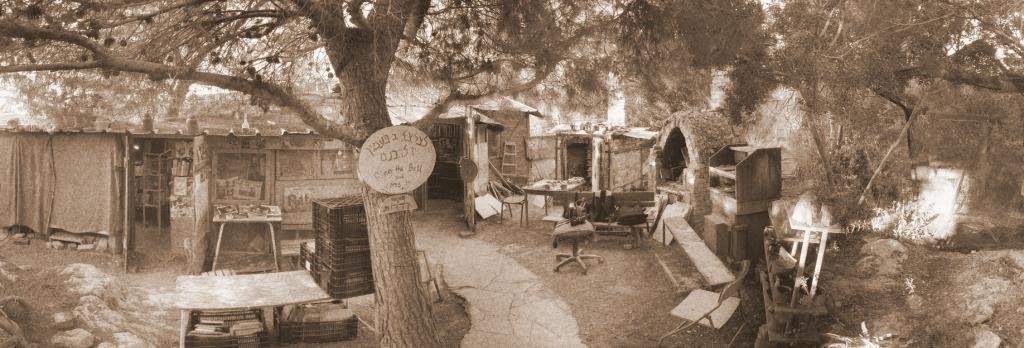
AP 2007 International art symposium in Ein Hod July1-10 #4


Gilad's Photos (via ein-hod-ap.com)

Thursday, July 5, 2007

Stephen Fry Shows His Inner Geek


VideoJug: Stephen Fry: The Internet
Stephen Fry is a British comedian who just happens to be insanely intelligent and creative. As well as being an actor and director, he has also been known to write the odd novel.
Most of you should be familiar with his film and TV work, but you may not know how big a technophile he is.
In this video he talks about the Internet, his experiences with it, as well as his favourite websites, all packaged with his usual dry wit.

Berlusconi , sex appeal and the Iron Lady


Margaret Thatcher was una bella gnocca, a "great piece of pussy", Silvio Berlusconi declared this week, eulogising his ideological heroine as he lashed out at Romano Prodi's government. The Italian media mogul has never shied away from the language of the public bar, but his choice of words to praise the former British prime minister was startling even by his standards. President François Mitterrand famously remarked of Baroness Thatcher that she had "the eyes of Caligula and the mouth of Marilyn Monroe". Evidently Mr Berlusconi's attention was focused elsewhere.
Gnocca, pronounced "nyokka", is a vulgar term meaning "vulva" and is the standard word used by construction workers, white-van drivers and long-serving Italian prime ministers for any attractive woman who crosses their path. "The typology is composed of elements of the female sex with a high degree of attractiveness," deconstructs one faintly priapic, cod-academic Italian website. "The fundamental characteristic of the gnocca is to grab from common mortals whatever she needs to satisfy her desires." A definition that many former Tory cabinet ministers would probably go along with.(more from Independent)