Tuesday, February 12, 2008

Herbie Hancock Walking from Miles to Grammy

Miles Davis All-Stars “Walkin” with Jay Jay Johnson (Trombone), Lucky Thompson (Tenor), David Schildkraut (Alto) Horace Silver (Piano), Percy Heath (Bass) and Kenny “Klook” Clarke (Drums). Prestige Records. Cover design by Hannah.
Session 9 (April 29, 1954)
This all-star session is among the key recordings in the history of modern jazz and the saga of Miles Davis.
Paradoxically (and the history of jazz is full of such paradoxes), the prognosis for history being made was anything but good. As Jules Colomby recalled, the musicians were to meet at Birdland in the afternoon for the ride to Van Gelder’s New Jersey studio. Lucky Thompson, coming in from Philadelphia, was so late that J.J. Johnson had just about talked the others into leaving without him when the tenorist arrived. At the studio, when all was ready, Miles told Bob Weinstock that he hadn’t brought his horn. Weinstock blanched. Colomby happened to have an old, leaky trumpet in the trunk of his car and Miles was able to coax from it the great playing heard here. (He also kept the horn, with the donor’s blessings.)

"Walkin’” (based on a piece known as “Gravy” when Gene Ammons first recorded it in 1950) is the masterpiece, however. At a more relaxed tempo the soloists preach brilliant sermons; Thompson may never have played better. As for Miles, he sums up why 1954 was a banner year for him. Not so incidentally, “Walkin’” became a cornerstone of the hard bop movement.(more from LP Cover Lover)
The Miles Davis Quintet digs into this Richard Carpenter classic on November 7, 1967 at the Stadthalle, Karlsruhe, Germany. This clip features Tony Williams, Wayne Shorter, Ron Carter and Herbie Hancock who looked shocked as his name was called to come to the stage and pick up the Grammy award for Album of the Year(2007!)Hancock’s River: The Joni Letters, a tribute to the songs of Joni Mitche.During his acceptance speech, Hancock noted that this was the first time in 43 years that a jazz album had nabbed the Album of the Year honors, the last one being Stan Getz and João Gilberto’s

Khayat's Bookshop is so close...

That we should still use the great forests of the world to disseminate our wisdom in the age of the internet is somehow appropriate, our love of books linking us to the prehistorical age of dinosaurs and pterodactyls, when the planet really was green.

I don't care if the books are "foxed" – if pages are brown-stained by the damp of ages – and that's just as well because Beirut is a dirty city, and in my seafront apartment, a mixture of exhaust fumes, industrial grime and the damp of the Mediterranean "foxes" even my newest books within a year. I once thought of moving them to Europe, then realised that their deterioration was part of their story, that they would always wear their history of Lebanon on their covers.
That's one reason why I love the old second-hand bookshop that Habib Aboujaudeh runs on Bliss Street. It's seen hard times – just like 75-year-old Habib. During the civil war, thieves stole thousands of pounds' worth of books from his store in west Beirut. "I lived in Ashrafieh in the east and my books were being sold on the streets of Hamra," he tells me. "I don't know why they took them. They can't have made much money." In Khayat's Bookshop – Habib inherited the name of previous owners – the smell of wood mixes with the odour of old stones. The store was once stables for the horses of the American University of Beirut, which still stands across the road, an academy founded by a 19th-century Quaker called Bliss.
Unlike Lebanon, Habib's shop is a cocktail of religions and literary style. There are Bibles and treatises on Islamic jurisprudence, tawdry romances from the 1950s, science lectures and the works of Ayatollah Khomeini and children's books and postcards of pre-war Beirut in which large American cars motor past 1930s hotels. Here you can find Alistair MacLean's Guns of Navarone in French, and Albert Vulliez's account of Churchill's destruction of the Vichy French fleet in Mers el-Kébir on 3 July 1940. "A hateful decision," Churchill called it in his own history of the Second World War (also in Habib's shop), "the most unnatural and painful in which I have ever been concerned."

by Rober Fisk-read more

Hope anf Die

Do emotions influence a cancer patient’s prognosis? In one of the largest, longest, and most controlled studies of its kind, researchers investigated whether the emotional state of cancer patients has any relationship to their survival.
At the start of the study, the participants completed a 27-item questionnaire used to evaluate the physical, social, and emotional quality of life in people with cancer and other chronic diseases. Five items targeted emotional state, asking patients to rate, on a scale of 0 to 4, the extent to which statements like “I feel sad” and “I am losing hope in my fight against my illness” had been true for them over the past seven days. The researchers then calculated a score for each person’s initial emotional well-being.
Coyne tracked patients for an average of nine years, until they either dropped out of the study or died. The study reported 646 deaths. Once the records for the participants were complete, researchers analyzed the data. “We were surprised to find absolutely no relationship” between emotion and survival, Coyne says(read more on Discover)
My old post on Placebo

Monday, February 11, 2008

Patterns Of Love: Estonian Sex


Written and presented by Desmond Morris (1997). How far would you go for love? Get ready to be amazed as you see people go further than ... all » you ever thought possible. Patterns Of Love will take you to a brothel in Nevada, love hotels for married adults in Japan and a bachelor auction in Alaska. You'll meet pop star Mongo Faya of Cameroon... and his 58 wives. Visit Istanbul's Topkapi Palace where the Sultans keep harems of hundreds of wives. Fly to Moscow with a group of American men hoping to bring home just one wife. And check out technology's answer to a troubled marriage: an automatic divorce machine that accepts all major credit cards. Patterns Of Love may change your definition of love. «

Sunday, February 10, 2008

Mating with relatives

Johann Sebastian Bach, Edgar Allan Poe, and Albert Einstein all married cousins. Maybe these creative geniuses were on to something. A new study suggests that mating with relatives has reproductive advantages.
Many societies regard inbreeding as taboo. Research seems to back this up, showing that children of related couples are more likely to inherit two copies of disease-causing recessive genes. Other work, however, has shown a positive outcome--namely, that married cousins have more children. But those studies--carried out in India and Pakistan--have not been conclusive because the data are hard to disentangle from social and economic factors. For example, poorer women tend not only to marry relatives but also to marry at a younger age, leaving more (read more>>)

Saturday, February 9, 2008

Umbrian Renaissance Pottery and Nano Glazes

Coloured glazes in pottery samples from the Umbrian town of Deruta exploit the reflective properties of minute metal grains to give them a rich lustre, Bruno Brunetti of the University of Perugia and colleagues find. At its peak in the fifteenth and sixteenth centuries, the finely painted ceramics of the Deruta pottery industry were in demand all over Europe.Glazes are basically thin films of coloured glass. Metal salts give colour to a glassy matrix produced by fusing sand alkalis such as soda in the heat of a kiln. Coloured glazes such as blue-glazed stone carvings from the Middle East have been around since at least 4500 BC.
Previous analyses of Umbrian Renaissance pottery showed that they had a chemical composition typical of the period: a mix of sand and alkali, with lead oxide added to reduce shrinkage and cracking.
Particles of metal of between 5 and 100 billionths of a metre across technically, a nanomaterial underlie this effect. Brunetti and colleagues found last year that red-and gold-lustre glazes contain particles of copper and silver, respectively, in this size range.Instead of scattering light, the particles' minute size causes light to bounce off their surface at different wavelengths, giving metallic or iridescent effects.Metal nanoparticles aren't the whole story, the team now finds. The red and gold glazes also contain traces of copper ions in what appear to be finely tuned amounts.Historical evidence for the early nanotechnology survives in the potter's handbook of around 1557, Li tre libri dell'arte del vasaio, by Italian craftsman Cipriano Piccolpasso. Copper and silver salts were mixed with vinegar, ochre (iron oxide) and clay and applied to the surface of pottery already coated with a glaze. A delicately regulated firing technique resulted in a pot with a lustrous surface.(via Nature)

Friday, February 8, 2008

Mazel-Tov , Bob Nechin's sixties look


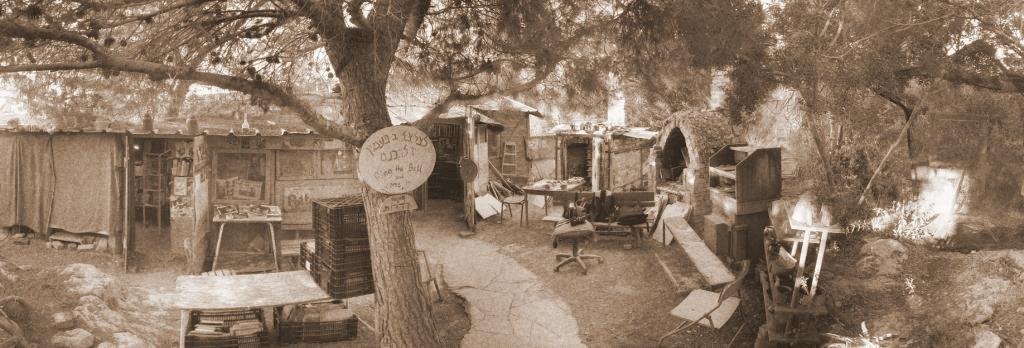
Photo by Boaz Tal

"After being discharged as a conscientious objector, he lived on communes, worked on ships pushing oil barges on the Ohio River and eventually took up..."

More about Bob Nechin Here

Wednesday, February 6, 2008

E-mail To My Dick


Rodney Carrington performing Letter To My Penis Live during his live show at the Majestic Theater in Dallas
For more Carrington click HERE
For more Penis pick HERE