Saturday, February 16, 2008

Spinning the Wheel

The Potter
The story begins as we enter a ceramic studio. The atmosphere is somber, enhanced with the use of a monochromatic palette. The potter's wheel spins as we see the hands of the potter sculpting something, which initially, is not visible to the human eye. When the potter's wheel comes to a stop, a clay figure emerges between the artist's hands.
The animation consists of a motion sequence performed by the clay figure, which is a metaphor for the emotions, which the artist experiences during the creation process. As the story unfolds, this sequence is also a visual metaphor for the potter's own healing process.
Composer: Nicolai Dunger
Filmmaker: Lena Dolata

Robert and his fellow bunnies


Szmolinsky is a 68-year-old German living in Eberswalde, near Berlin, who won a prize for breeding a 10.5-kilogram (23.1 pound) rabbit named Robert in 2006. Robert was the size of a small dog. When North Korean leaders saw photos of him they contacted Szmolinsky through a breeding federation, hoping to purchase a line of "German Giant Grays" to alleviate hunger in their hermetic Communist state.
Szmolinsky grew up in East Germany, and he agreed to help.
Szmolinsky had made the North Koreans a special price of €80 per rabbit instead of the usual €200 to €250. He had said in January that the 12 rabbits, capable of producing 60 babies a year, were being kept in a petting zoo in the North Korean capital Pyongyang pending his arrival.Szmolinsky said he suspected Robert and his fellow bunnies had been eaten by top officials and that that was the real reason why he wasn't getting a visa. "That's an assumption, not an assertion," he added. "But they're not getting any more."(read more>>)

Stop jerking gadget for $2,906.00

Somebody was ready to pay $2,906.00 for an unusual antique - an anti-masturbation device.The rare 19th century item is made of copper and was designed to be worn by boys so they could not commit the 'sin'.Attached to a belt it would have encased the genitalia.The bizarre antique dates back to around 1880 and was used in Catholic France.It is being offered for sale on auction website eBay with a starting price of £750.Seller David Burns, of Curious Science,says that during a quarter of a century dealing in medical curiosities he has never had one for sale. It is described as an 'extremely rare anti-masturbation device dating from 1880'. The listing continues: "The copper, shaped device was attached to a belt and worn by boys as a means of preventing nocturnal emissions."
"This is the first example we have offered for sale in 24 years. The condition is excellent. Three and half inches top to base."(read more on Rex)

Thursday, February 14, 2008

Mercy, Mercy, Mercy


Beginning with the genius Louis Armstrong's triumphant return to Ghana in the late 1950's, we trace the evolution of music from West Africa to the Virginia colonies of the early 1600's. Over the next 400 years, as this distinct root of American culture takes hold, incredible clips of filmed performances by Mahalia Jackson, Josephine Baker, Bessie Smith, Count Basie, Billie Holiday, Coleman Hawkins, Roy Eldridge, and Duke Ellington illustrate the black experience.
Contemporary musicians such as Nina Simone, BB King, Cannonball Adderly (w/ Joe Zawinal - Mercy, Mercy, Mercy), and Sly & the Family Stone, along with a funky-ass filmed number from an as-yet-undocumented-on-the-internet off-Broadway production called "The Me Nobody Knew" punctuate the memory of the past, the spontaneity of the moment and determination for the future.

British Library's Rotten War


How do I eliminate or reduce a musty odor in a book?
This musty smell is most often noted in books that have been moldy or mildewed in the past. The first step is to create an enclosed chamber. This is most easily done by using two garbage cans, one large (with a lid) and one small. The object to be "deodorized" should be placed in the smaller can, which is then placed inside the larger can. Some type of odor-absorbing material should then be placed in the bottom of the larger can. Odor-absorbing materials to try include baking soda, charcoal briquettes (without lighter fluid), or kitty litter. The lid should then be placed on the larger can, and the chamber should be left for some time. You will need to monitor periodically to see how long the materials need to be left inside the chamber.
How would I remove spots of mildew that are on the cover of a book?
If you have mold or mildew on a book do the following: get a slightly damp cloth and gently wipe the stop of the book working away from the book (i.e. start at the spine side and work out towards the foredge). Do this over a garbage can, preferably outside. The mold spores will get into the air and if you are outside you won't be spreading the spores into your house.
A weak solution of boric acid may also be used to dampen the cloth and wipe off the stain. After cleaning throw away_ the cloth (this has mold on it, get rid of it), and wash your hands. Let the book dry (this shouldn't take too long because the cloth should not be too wet) and then store in a cool, dry location. The key to avoiding mildew and mold is a safe storage environment. You may still have a stain but most of the spores will have been removed.(read more)

We are tired

Richard Sennett’s The Craftsman continues an argument begun in the 19th century, when writers such as John Ruskin and William Morris extolled the crafts remembered in our surnames (Smith, Cartwright, Thatcher, Mason, Fletcher) while lamenting the mind-numbing and soul-destroying labour of the industrial process which was replacing them. A long line of thinkers, from Hegel and Marx to Sennett’s teacher Hannah Arendt, have sympathised with the argument. But Sennett does not think that craftsmanship has vanished from our world.

The word "craftsman" summons an immediate image. Peering through a window into a carpenter's shop, you see an elderly man surrounded by his apprentices and his tools. Order reigns within: parts of chairs are clamped neatly together, the smell of wood shavings fills the room, the carpenter bends over his bench to make a fine incision for marquetry. The shop is menaced by a furniture factory down the road.
The craftsman might also be glimpsed at a nearby laboratory. There, a young lab technician is frowning at a table on which six dead rabbits are splayed on their backs, their bellies slit open. She is frowning because something has gone wrong with the injection she has given them; she is trying to figure out if she did the procedure wrong, or if there is something wrong with the procedure.
A third craftsman might be heard in the town's concert hall. There, an orchestra is rehearsing with a visiting conductor; he works obsessively with the string section, going over and over a passage to make the musicians draw their bows at exactly the same speed across the strings. The string players are tired, but also exhilarated because their sound is becoming coherent. The orchestra's manager is worried: if the visiting conductor keeps on, the rehearsal will move into overtime, costing management extra wages. The conductor is oblivious
.(
read more Here and Here)
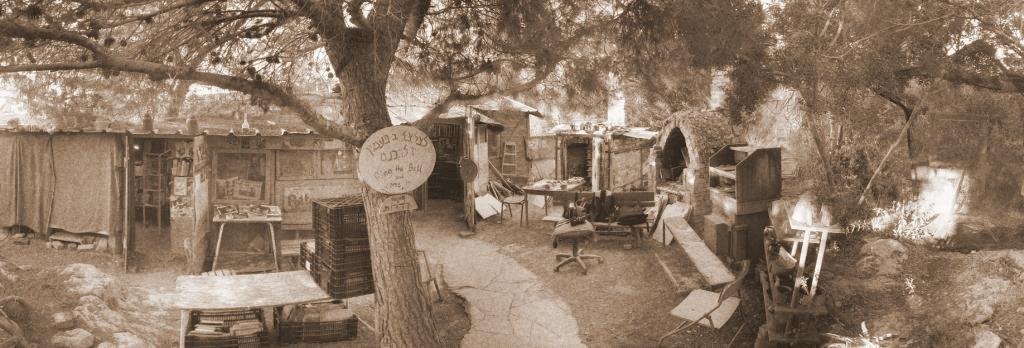
Photo of Itche Mambush from Ein Hod Site

Wednesday, February 13, 2008

reCAPTCHA your CAPTCHA


Computer scientist Luis von Ahn is best known for inventing those twisted, blurry words that websites ask you to type to post a comment or send an email. reCAPTCHA is the process of utilizing CAPTCHA to improve the process of digitizing the text of books. It takes scanned words that optical character recognition software have been unable to read, and presents them for humans to decipher as CAPTCHA words

Leah's eyes

Nicknamed George and Leah, two lowland gorillas in Congo mate face-to-face in the first ever photograph of wild gorillas engaging in the behavior. Leah is one of four females in George's harem.
Released to the public on February 12, 2008, the 2005 pictures originally accompanied a report in a spring 2007 issue of the Gorilla Gazette, a newsletter for gorilla scientists.
"Leah was lying on the ground and George was looking into Leah's eyes," researchers wrote in the report.
German conservation biologist Thomas Breuer, who took the photos, told National Geographic News, "It leads me to think about how similar gorillas can be to humans, [and yet] we humans are destroying them."(read more>>)