Scientists were fascinated by the ghostly find: a human skeleton buried in an Aztec temple with a clay, skull-shaped whistle in each bony hand. But no one blew into the noisemakers for nearly 15 years. When someone finally did, the shrill, windy screech made the spine tingle.If death had a sound, this was it. Roberto Velazquez believes the Aztecs played this mournful wail from the so-called Whistles of Death before they were sacrificed to the gods. The 66-year-old mechanical engineer has devoted his career to recreating the sounds of his pre-Columbian ancestors, producing hundreds of replicas of whistles, flutes and wind instruments unearthed in Mexico's ruins. Velazquez is part of a growing field of study that includes archaeologists, musicians and historians. Medical doctors are interested too, believing the Aztecs may have used sound to treat illnesses. The modern-day archaeologists who came up with the term Whistles of Death believe they were meant to help the deceased journey into the underworld, while tribes are said to have emitted terrifying sounds to fend off enemies, much like high-tech crowd-control devices available today. Experts also believe pre-Columbian tribes used some of the instruments to send the human brain into a dream state and treat certain illnesses. The ancient whistles could guide research into how rhythmic sounds alter heart rates and states of consciousness. Among Velazquez's replicas are those that emit a strange cacophony so strong that their frequency nears the maximum range of human hearing. Chronicles by Spanish priests from the 1500s described the Aztec and Mayan sounds as sad and doleful, although these may have been only what was played in their presence. (read more...) In our Ein Hod "Always Open" pottery we make ocarinas for live people.
Jesse Helms, the former North Carolina Senator whose courtly manner and mossy drawl barely masked a hard-edged conservatism that opposed civil rights, gay rights, foreign aid and modern art, died July 4, 2008. He was 86. Citing the "proliferation of immoral and offensive material throughout America's museums and schools," and waving placards emblazoned with agit-prop fotocollage reading, "diE KUnst ISt tOT, DadA ubEr aLLes" ("Art is dead, dada over all"), a coalition of leading Republican congressional conservatives and early 20th-century Dadaists declared war on art in a joint press conference Monday. Anti-art crusaders Sen. Jesse Helms (R-NC) and Dadaist provocateur Tristan Tzara call for the dismantling of the institutions regulating public art in a joint press conference Monday. Calling for the elimination of federal funding for the National Endowment for the Arts; the banning of offensive art from museums and schools; and the destruction of the "hoax of reason" in our increasingly random, irrational and meaningless age, the Republicans and Dadaists were unified in their condemnation of the role of the artist in society today. "Homosexuals and depraved people of every stripe are receiving federal monies at taxpayer expense for the worst kind of filth imaginable," said U.S. Sen. Jesse Helms (R-NC), a longtime NEA critic. Dadaist Jean Arp agreed. "Dada is, like nature, without meaning. Dada is for nature and against art," he said. Added nonsense-poet Hugo Ball, founder of Zurich's famed Cabaret Voltaire: "...'dada' ('Dada'). Adad Dada Dada Dada." Donning an elaborate, primitivist painted paper mask, he then engaged reporters in a tragico-absurd dance, contorting wildly while bellowing inanities. Helms, well known for his opposition to arts funding, was adamant in his demand for the elimination of the NEA from the national budget. "The American people will no longer stand for vulgar, nonsensical displays that masquerade as art," said Helms, who, along with U.S. Sen. Orrin Hatch (R-UT), demanded the passage of obscenity laws granting police and government officials broader powers in the prosecution and censorship of art. In a show of solidarity with the Republican legislators, Andre Breton, who founded the surrealist movement in 1923, fired a pistol at random into the crowd, conceptually evoking the hideous irrationality of the collective unconscious and wounding Hatch. Urging reporters to "imagine a boot stamping on a face, eternally," Breton, along with Max Picabia, the most radical anti-art proponent within the Dadaist camp, then theatrically demonstrated Helms' vision. In a collaborative staged "manifestation," Picabia pencilled a series of drawings, which Breton erased as Picadia went along. "So-called modern art is, at its core, an absurd and purposeless exercise," Helms said, echoing the Dadaists' illustration of the meaninglessness of art. He then announced the Gramm-Helms Decency Act, a bill that would facilitate the legal prosecution of obscenity, as well as establish stiffer penalities for the creators and exhibitors of "morally objectionable works." Dadaist leaders were even more strident than Helms, stressing the need for the elimination of not only art, but also of dada itself. "To be a Dadaist means to be against dada," Arp said. "Dada equals anti-dada." Urging full-scale rioting, the assembled Dadaists called for their own destruction, each of them alternately running into the audience to pelt those still on stage with tomatoes. In a gesture honoring Helms and the new bill, seminal anti-artist Marcel Duchamp drew a moustache and beard on a reproduction of Leonardo da Vinci's Mona Lisa. Duchamp titled the resultant image "L.H.O.O.Q.," a series of initials which, when pronounced in French, forms the sentence "Helms au chaud au cul," or "Helms has hot pants." Centered in Berlin, Paris and Zurich, the Dadaist movement was launched as a reaction of revulsion to the senseless butchery of World War I. "While the guns rumbled in the distance," Arp said, "we had a dim premonition that power-mad gangsters would one day use art itself as a means of deadening men's minds." When told of Arp's comments, Helms said he was "fairly certain" that he concurred. (from onion)
The merry cemetery of Sapanta has been, for more than fifty years, the creation of sculptor Stan Patras, the successor of several generations of wood artists that bequeathed their trade from father to son. In the beginning he sculpted about ten crosses a year. The method of work has been preserved unaltered to thisday. The oak wood is cut into beams that are then allowed to dry one or two years. Next they are hewn into 10-cm thick planks, 2.20 m long and 30-40 cm wide, ranged in stacks, and allowed to dry for some months more. Then the sculptor begins his work: first he draws the geometrical motifs and the bas-relief dedicated to the deceased, then he sculpts and paints the cross in blue - a symbol of hope and freedom. In 1934, Patras began to scribble an epitaph on the crosses. Usually it is a short poem written in the first person, dotted with archaisms, vernacular phrases and...spelling errors.
The sculptor-poet's source of inspiration is the two-three night wake. The relatives of the dead person do not mourn, but drink and make merry. The entire life of the village is featured in this cemetery. The shepherd, the farmer, the wood ranger, the wood cutter, or the pupil stand side by eternally, with the weaver, the spinner, the housewife, the merchant, the carpenter, the doctor, the musician or the drunk. This colective memory of Sapanta, this ensemble of colourful graves where each dead peson recounts humbly his/her existence with its joys and sorrows, creates a serene and merry atmosphere, a sort of challenge to death, a hymn to life.
Lenka Reinerova, the last of Prague's circle of authors who wrote in German, has died.She died Friday in Prague, Czech public radio said. She was 92.Reinerova was one of a number of German-speaking authors — Franz Kafka, Franz Werfel and Rainer Maria Rilkewere among the others — who lived and wrote in Prague before World War II. The city, then the Czechoslovak capital, had strong German and Jewish populations, and a thriving literary community.But the war changed that.Nearly 120,000 Jews lived on Czech territory before WWII; 80,000 of them did not survive the Holocaust. The country now has a Jewish community of only several thousand.And about three million Germans were expelled from Czech lands after WWII. They were considered enemies because many had supported Adolf Hitler and the Nazi occupation."She was part of something that ceased to exist some 60 year ago a Czech-German-Jewish coexistence, which was once typical for the city," Reinerova's Czech publisher, Joachim Dvorak, told Czech public radio. Reinerova was born in Prague to a Jewish family on May 17, 1916. After studying at Prague's German high school, she began working in 1936 as a journalist for the Arbeiter-Illustrierte-Zeitung magazine.Because she was Jewish, she had to flee the country in 1939 to escape Nazism. She traveled through France and Morocco, where she was jailed, finally reaching Mexico. But her family died in the Holocaust. After the war, Reinerova moved to Belgrade before returning to Prague in 1948, when the country was taken over by the communists.In the 1950s, she was jailed for 15 months by communist authorities.In the next decade, she worked as editor-in-chief of the Im Herzen Europas magazine. After the 1968 Soviet-led invasion of Czechoslovakia, which crushed the democratic reforms known as the Prague Spring, she was not allowed to publish books and worked instead as a translator. Her books, mostly autobiographical, began to be released in Germany in the 1980s. But she remained little-known in her own country, where her books were allowed to be published only after communism fell in 1989. "As I am the only member of my family who was not murdered in the Holocaust," Reinerova told Czech radio in 2004. "As I am still here rather old already I can remember many things and I can remember persons, not only personalities. So I have somehow the feeling, I feel the necessity, as long as I can give some kind of witness, (to give) some kind of testimony."
At the Royal Society's Summer Science Exhibition the public were invited to touch and feel 20 wood and wood effect samples and vote on whether they are real or not. The exhibition will now be toured around the UK during the next year to collect a census of data from across the country. This will then be used to help build the first predictive model of how we judge naturalness The physical characteristics of a surface, such as its colour, texture and surface roughness, are being linked to what is happening in a person's brain when they see or touch the surface. Once this is understood it should be possible to accurately predict what we will perceive as natural, and manufacturers will be able to design synthetic products to meet this expectation. The results could have a great impact on materials such as wood, animal skin and furs, marble and stone, plants and even prosthetics. Ruth Montgomery of the National Physical Laboratory, said: "Our senses combine to identify natural materials. But what are the key factors, is it colour, gloss, smoothness, temperature? This is what our research is trying to establish. The focus of the research is wood, fabric and stone, but once the data is combined the aim is to produce a predictive computer model that will work for other materials. If successful the range of applications would be huge. For instance, synthetic mahogany furniture that is indistinguishable from the natural material, but won't rot or be attacked by woodworm or artificial grass so good that they use it on Wimbledon's Centre Court."
The filthy vermin which afflict us must be exterminated. Animal-lover or not, the human extinct is pure: to pluck from our scalps the bulbous, blood-filled ticks; to drown in baths the dust mites that feast on our skin; to chop in half the tiny rodents that so delight in perching on our upper lips while we slumber and meticulously squeeze dropping after dropping into our snoring mouths. As they do. But mice and rats are a canny lot. How to kill them, not only with ruthless efficiency but with negligible pangs of guilt? In 1894, William C. Hooker of Abingdon, Illinois received a patent for his design for the first spring-loaded bar mouse trap. It was later perfected by Hiram Maxim to be the mouse trap we all know today: a simple plank of pine, attached to which is a clamp triggered by a spring and depressed with a slice of cheese. When a mouse or rat pokes its plaguey snout at the cheese, the spring depresses, the clamp snickersnacks and the mouse has its neck cleanly broken. What the guillotine is to the French, the mouse trap is to unhygienic Americans. A spring-loaded mousetrap is (usually) a clean way to kill a mouse. But spring for a non-lethal trap out of the kindness of your heart and when you release that mouse, you'll see it poking out of your Cheerios the next morning. Try a glue trap, and you'll hate yourself for years as you torture a cute, fuzzy animal to death. And poison is a painful crapshoot. Oh, sure. It's a cruel gizmo. But it is perfectly designed: "build the better mousetrap" has become an ironic cultural shorthand for "waste of time." (from"10 Perfectly Pure Gadgets")
Isle of Flowers (Portuguese: Ilha das Flores) is a 1989 Brazilian short film by Jorge Furtado. It tracks the path of a tomato from garden to dump with the help of a monotone voiceover and a collection of bizarre images. While a very humorous film, the message it delivers about how human beings treat each other is anything but such. The director himself has stated that the film was inspired by the works of Kurt Vonnegut and Alain Resnais, among others. The film has been denounced as "materialistic" because one of its early credits displays the phrase "God doesn't exist". Nevertheless, critic Jean-Claude Bernardet defined Isle of Flowers "a religious film", and the Brazilian National Bishop Confederation awarded the film with the Margarida de Prata (Silver Daisy), calling it "the best Brazilian film of the year" in 1990. In 1995, Isle of Flowers was chosen by the European critics as one of the 100 most important short films of the century.(read more...)
Every day, we make decisions on topics ranging from personal investments to schools for our children to the meals we eat to the causes we champion. Unfortunately, we often choose poorly. The reason, the authors explain, is that, being human, we all are susceptible to various biases that can lead us to blunder. Our mistakes make us poorer and less healthy. "Nudge: Improving Decisions About Health, Wealth, and Happiness" shows that by knowing how people think, we can design choice environments that make it easier for people to choose what is best for themselves, their families, and their society. Using colorful examples from the most important aspects of life, Thaler and Sunstein demonstrate how thoughtful "choice architecture" can be established to nudge us in beneficial directions without restricting freedom of choice. Richard H. Thaler is the Ralph and Dorothy Keller Distinguished Service Professor of Behavioral Science and Economics and the director of the Center for Decision Research at the University of Chicago's Graduate School of Business. (read more on einhod blog...)
ein hod pottery
נעמי וזאב ורוכבסקי
קדרות עין הוד
קורס קדרות- (מגיל 13)
לימוד טכניקות באובניים בחומר
צביעה בגלזורות ושריפה בתנור גז
סדנת שבת,חגים,ימי קיץ,ימי חול
-עבודה בחומר לכל הגלאים-עבודת יד -התנסות באובניים מגיל 13 (60 דקות)
לקבוצות
-סדנת הדגמה-הסבר והדגמה באובניים והתנסות קצרה לכל משתתף
(עד 25 איש, 40 דקות)
-סדנה פעילה-הסבר והדגמה באובניים ועבודה לכל משתתף באובניים אישי. עד 16 משתתפים, שעה וחצי
פרטים- נעמי וזאב ורכובסקי.
0507757142
----------
0506889820
----------
049841107
zenobooks@yahoo.com
Ein Hod Bookstore (Zenobooks)
10 000 books on Findabook.co.il *****
ספרים בכפר
עין הוד-תמיד פתוח
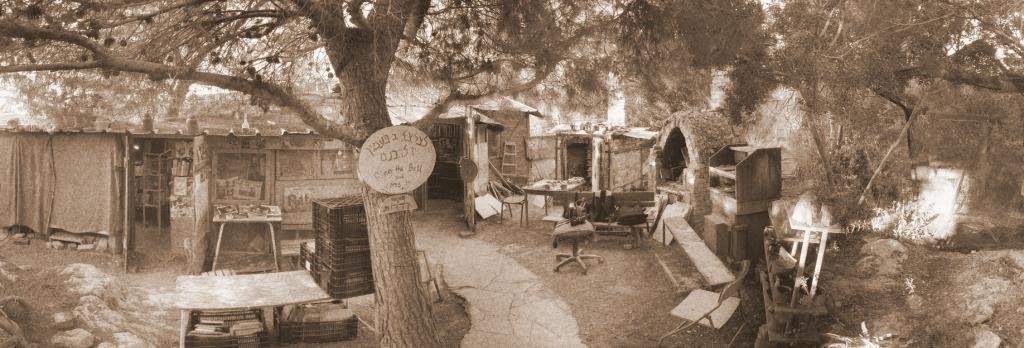
הסטודיו לקדרות של נעמי וזאב הוא הרבה יותר מסטודיו לקדרות. הוא יהיה הקינוח שלכם ליממה האמנותית. מה אפשר לעשות כאן? חובבי ספרים ישמחו לגלות אלפי כותרים נושנים, מסודרים ברישול מלא חן, בערימות, במחסן חורק או תחת כיפת השמים. מצאנו כאן, למשל, את "פתגמים ומכתמים" האלמותי של חנניה רייכמן, את המחזה "מחכים לגודו" של סמואל בקט, ואפילו ספר הדרכה ישן ומוזר בשם "שיפור הראייה ושחרור העיניים מהמשקפיים כיצד" (כך במקור).רוצים ליצור אמנות ולא רק לצפות בה? נעמי מעבירה סדנאות קדרות לילדים (שמפסלים) ולמבוגרים (שגם מתנסים בעבודת אובניים). גם משפחה אחת יכולה לתאם, להגיע, ולזכות בחוויית יצירה יוצאת דופן. נכון, זו רק טעימה זעירה מעולם הקדרות, אבל גם מטעימות יוצאים לעיתים דברים מופלאים. תהיו חייבים להודות שמדובר במקום עם נשמה, שהולכת ומתמעטת יותר ויותר
במחוזותינו.
פרטים בטלפון 0506889820zenobooks@yahoo.com
( MAKOהכתבה ב)
"FUCK!"
-
"Tancredi Bollocks Face strode into the Laboratory. It had originally been
called the Conservatory. but he had recently changed his politics.
Suddenly he ...
החממה החינוכית בכפר הנוער ימין אורד
-
הנכם מוזמנים לחגוג אתנו את חג סוכות
בטכס השקת מיזם החממה החינוכית בכפר הנוער ימין אורד
יום ראשון י"ח בתשרי תשע"ב חוהמו"ס
16.10.2011 החל מהשעה 11.00
בסוכת ה...
(חול (מאת אימיגרנט
-
"וכי תבואו אל הארץ ונטעתם כל עץ מאכל , וערלתם ערלתו ..." (ויקרא יט,כג).
מהי אבן היסוד של אמונה? דבקות? צניעות? גמילות חסדים?
לא ולא. אבן היסוד היא ספק. ...


 Posts
Posts