Sunday, May 31, 2009

His Private Language


Dan Zaretsky studied sculpture with Rudy Lehman. As a sculptor, Zaretsky learned bronze casting which helped him in the field of his art. He learned to take advantage of the lesser known possibilities inherent in bronze sculpture; here, Zaretsky has unique accomplishments.
Zaretsky is a figurative sculptor who has a private language. It seems to me that his private language is drawn from ancient Assyrian sculpture, which was mainly the art of relief. Zaretsky creates sculptures in bronze that are extremely thin-but they are, nonetheless, very, very three dimensional. Here, there is a mutual understanding between the art of sculpture, and the art of relief. In bas-relief, figures are sculpted on a tablet of stone, wood, or other material, and the figures cast shadows and create the illusion of three dimensions. In haut-relief, perspective is also created. What Zaretsky accomplishes, and in my opinion he is the first to do so, at least for us here, is to create a sculpture that is so very thin that it is a deep relief, on both its sides.(more...)

Friday, May 29, 2009

Stoke-on-Trent 1932

These are scenes taken at the Spode factory in Stoke-on-Trent around 1932. It’s typical of many items in the Film Archive showing the pottery industry. Films began to be made at this time to promote the sale of pottery – particularly abroad. It was the height of the Depression, and so there was a reason for these films to be made. And they show all the processes of pottery making from the arrival of materials through to the finished goods going out.

There are some valuable glimpses here of girls carrying unfired ware to be put into saggars (or safeguards) so that they can be fired in the bottle oven. And here we see the placer placing the ware into a saggar, which is then carried on his head and stacked inside the bottle oven ready for firing. The safeguards – or saggars – are to keep the flame off the ware so that it’s baked inside these protective fireclay cases, This is the era of coal firing. This film also features in the documentary; “Stoke-on-Film, 1930s”, produced by Ray Johnson. Source: Staffordshire Film Archive

Wednesday, May 27, 2009

Bernard-Henri Zizek (israel, israel,israel...)


Bernard-Henri Levy, France's "rock-star philosopher," and Slavoj Zizek, the Slovanian "Elvis of cultural theory," will scrutinize the totalitarianisms of the past as well as those of the future, as they argue for a new political and moral vision for our times and investigate the limits of tolerance.
Does the advent of capitalism cause more violence than it prevents? Is there violence in the simple idea of the neighbor? asks Zizek in Violence: Six Sideways Reflections.
Are human rights Western or Universal? How is it that progressives themselves-those who in the past defended individual rights and fought fascism-have now become the breeding ground for new kinds of dangerous attitudes? - New York Public Library
Slavoj Žižek's work triggers continuous controversy; Welcome to the Desert of the Real, his analysis of 9/11, was attacked both as anti-Semitic in Israel and as Zionist in Egypt. He is the author of more than thirty books and is the subject of the documentary Žižek. His own critically acclaimed documentary, The Pervert's Guide to Cinema, was the subject of a film retrospective in 2007 at the Museum of Modern Art.

Friday, May 22, 2009

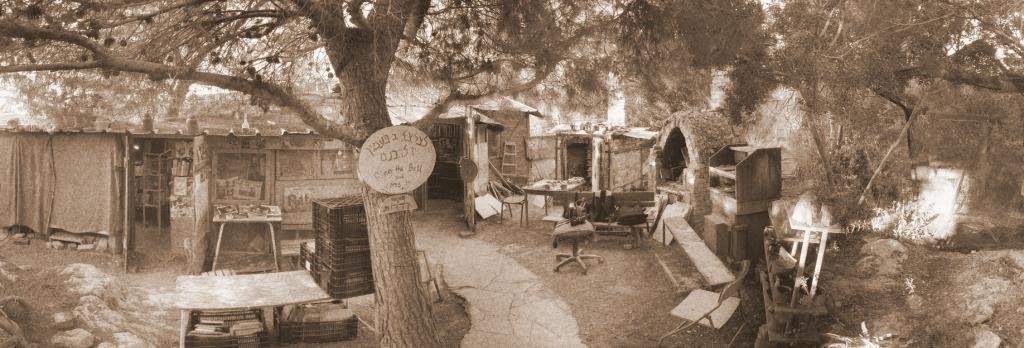
Ein Hod Pottery


We create hand made pottery: functional stoneware pots thrown on the potter's wheel, decorated with various glazes, fired in a gas kiln to a high temperature.
Our pottery studio has been open to the public since 1982. We welcome visitors seven days a week and sell a variety of pottery: bowls, plates, casseroles, mugs (all of which can be used for cooking and serving food and drink), boxes, vases, and ocarinas(clay whistles and flutes).
We teach weekly pottery classes all year and conduct short workshops for groups and individuals during the week and on Saturdays and holidays(all ages).
We have a book shop where we sell a large selection of used and rare books in all languages.
For more information about our studio and activities and/or help in arranging visits and workshops with other artists please contact us:
Naomi and Zeev 04-9841107. zeno@netvision.net.il
Second hand books
At zeev Verchovsky "Pottery Always Open" #33 on the map
Accommodation and cafes are also available in the village.

קורס קדרות- (מגיל 13)

לימוד טכניקות באובניים בחומר,

צביעה בגלזורות ושריפה בתנור גז.

סדנת שבת,חגים,ימי קיץ,ימי חול.

-עבודה בחומר לכל הגלאים-עבודת יד.

-התנסות באובניים מגיל 18 (30-40 דקות)

לקבוצות

-סדנת הדגמה-הסבר והדגמה באובניים והתנסות קצרה לכל משתתף

(עד 25 איש, 40 דקות)

-סדנה פעילה-הסבר והדגמה באובניים ועבודה לכל משתתף באובניים אישי. עד 16 משתתפים, שעה וחצי

פרטים- נעמי וזאב ורכובסקי.
טל 9841107 04

Awkward and Disgusting meet Bizarre and Hilarious


"Copulation," said Leonardo da Vinci, "is awkward and disgusting." Despite his aversion, Leonardo was the first to attempt a cross-sectional anatomical drawing of coition. Some 500 years later, Mary Roach offered herself and her husband as guinea pigs for the modern equivalent: dynamic 3D ultrasound imaging. Although not disgusting, the process is certainly awkward. "Now please make some sort of movement," the scientist tells them as he positions the imaging equipment. Roach certainly gets full marks for unflinching commitment to the job in hand. In search of a link between fertility and orgasms, she visits a pig farm for tips on the best way to stimulate a sow. The Danish government publishes a Five-Point Stimulation Plan; there were six points, but farmers balked at sow vibrators (from Guardian)
(more on the blog...)

Wednesday, May 20, 2009

Five-a-day keeps smaller farms away

Eating more healthily might be better for us as individuals, but would it be bad news for farmers? A research project funded by the UK Research Councils’ Rural Economy and Land Use Programme had found that if we all followed government advice to eat five portions of fruit and vegetables a day this could have serious implications for the countryside.
Their research shows that, if we assume that the percentage of imports will remain constant, many more hectares of intensive production under polythene tunnels would be needed in order to produce the quantity of fruit and vegetables for the recommended healthy diet.
At the same time, areas such as Wales and the south west, which are most suited to grazing animals rather than growing crops, would suffer a severe decline in such production. For example, in Wales, cattle numbers would fall by some 400,000 head and sheep numbers would be halved. In the north of England both sheep and cattle numbers would fall by 200,000 head each.
This could mean unemployment in, and abandonment of, upland areas. Smaller farms would disappear and be absorbed into larger land holdings. Upstream industries would suffer, particularly feed suppliers, and there would be a knock-on effect on the wider rural economy of the uplands.
(read more...)

Monday, May 18, 2009

35,000 Years Old: Art or Porn?


The short, squat torso is dominated by oversize breasts and broad buttocks. The split between the two halves of the buttocks is deep and continuous without interruption to the front of the figurine. A greatly enlarged vulva emphasizes the “deliberate exaggeration” of the figurine’s sexual characteristics.


Nicholas J. Conard, an archaeologist at the University of Tübingen, in Germany, who found the small carving in a cave last year, said it was at least 35,000 years old, “one of the oldest known examples of figurative art” in the world. It is about 5,000 years older than some other so-called Venus artifacts made by early populations of Homo sapiens in Europe.(more ...)

Thursday, May 14, 2009

Are You Happy?


As a young man, Vaillant fell in love with the longitudinal method of research, which tracks relatively small samples over long periods of time (as in Michael Apted’s Seven Up! documentaries). In 1961, as a psychiatric resident at the Massachusetts Mental Health Center, Vaillant found himself intrigued by two patients with manic depression who had 25 years earlier been diagnosed as incurable schizophrenics. Vaillant asked around for other cases of remitted schizophrenia and pulled their charts. “These records hadn’t been assembled to do research,” Vaillant told me recently, “but it was contemporary, real-time information, with none of the errors you get from memory or the distortions you get when you narrate history from the vantage of the present.” In 1967, after similar work following up on heroin addicts, he discovered the Harvard Study, and his jaw dropped. “To be able to study lives in such depth, over so many decades,” he said, “it was like looking through the Mount Palomar telescope,” then the most powerful in the world. Soon after he began to work with the material, he found himself talking about the project to his psychoanalyst. Showing him the key that opened the study cabinets, Vaillant said, “I have the key to Fort Knox.”

(read more...)